Map your home electrification journey. Weigh the cost-benefit, then decide.
WhyWatt? is a community-developed, transparent tool to explore your electrification options, timeline, and benefits for your home.
02 · Meet WhyWatt · 1 of 3
The cockpit — your energy bottom line, up front
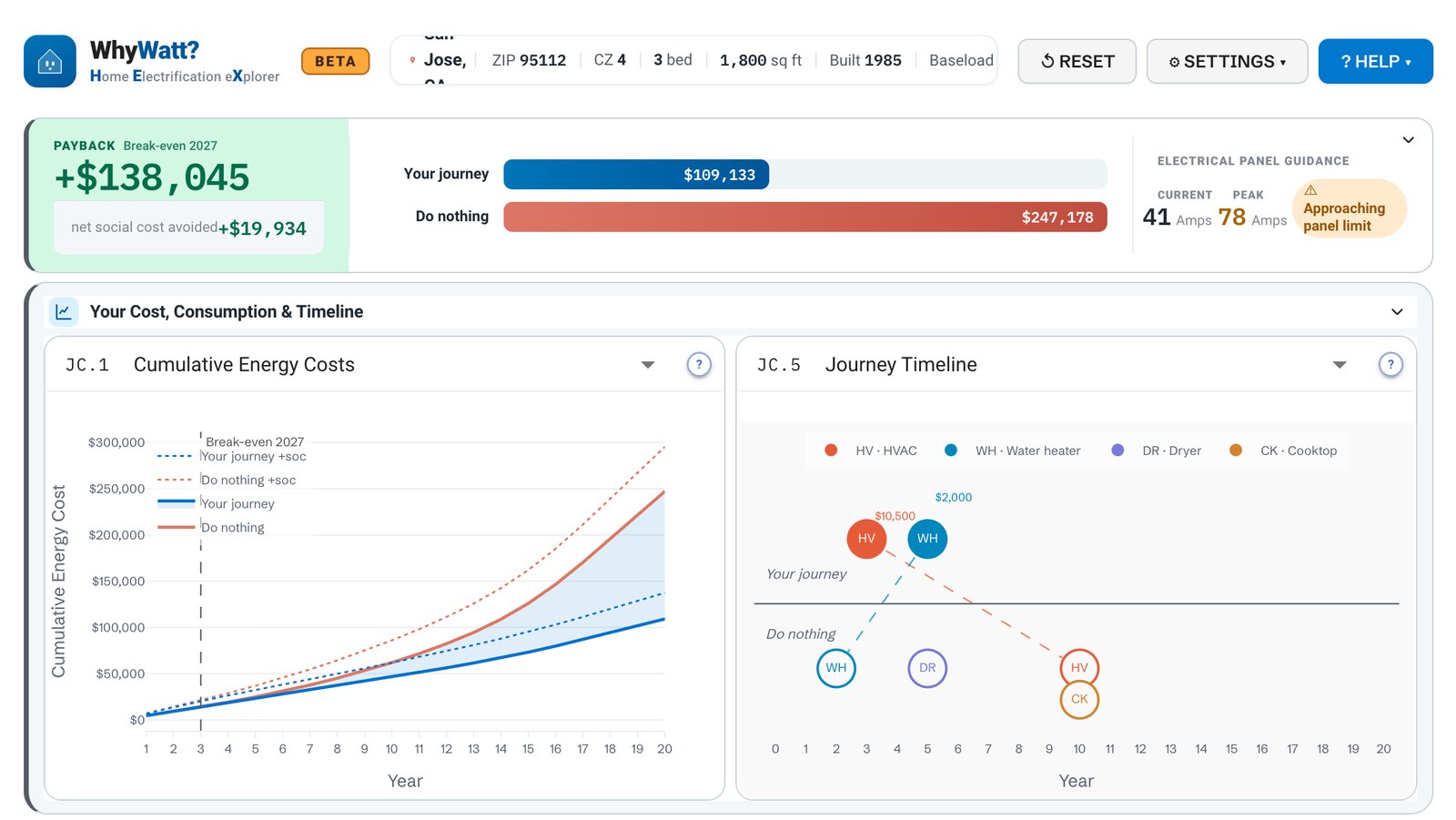
- Break-even 2027 — the first year your journey's energy cost comes out ahead. +$138,045 is the saving over the 20-year model.
- Two futures. Journey $109,133 vs. do nothing $247,178; dotted lines add social cost (+$19,934 avoided).
- Panel guidance. 41 A today, 78 A peak.
Rates: WhyWatt Conservative (default) for electricity & gas.
03 · Meet WhyWatt · 2 of 3
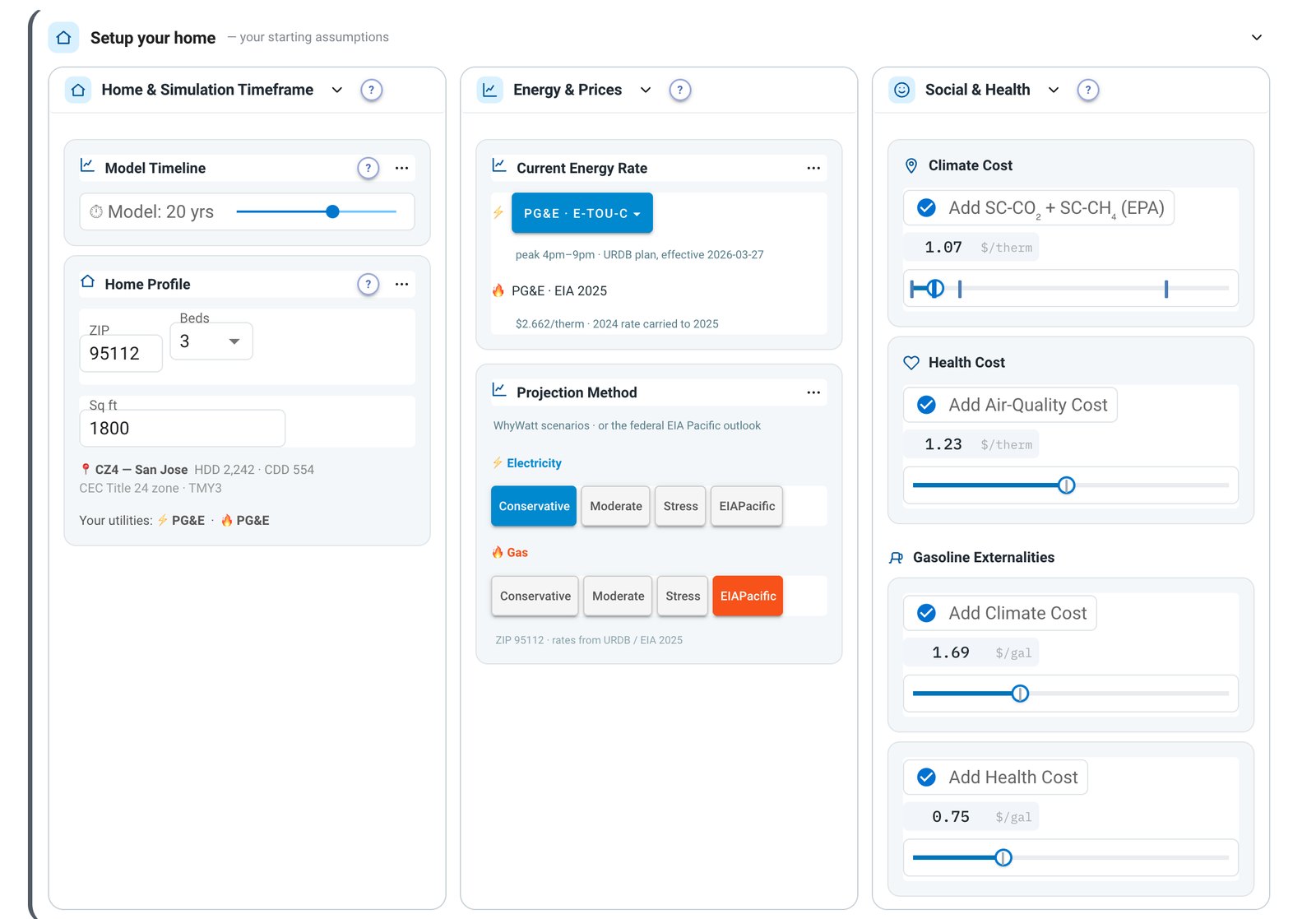
Set up your home
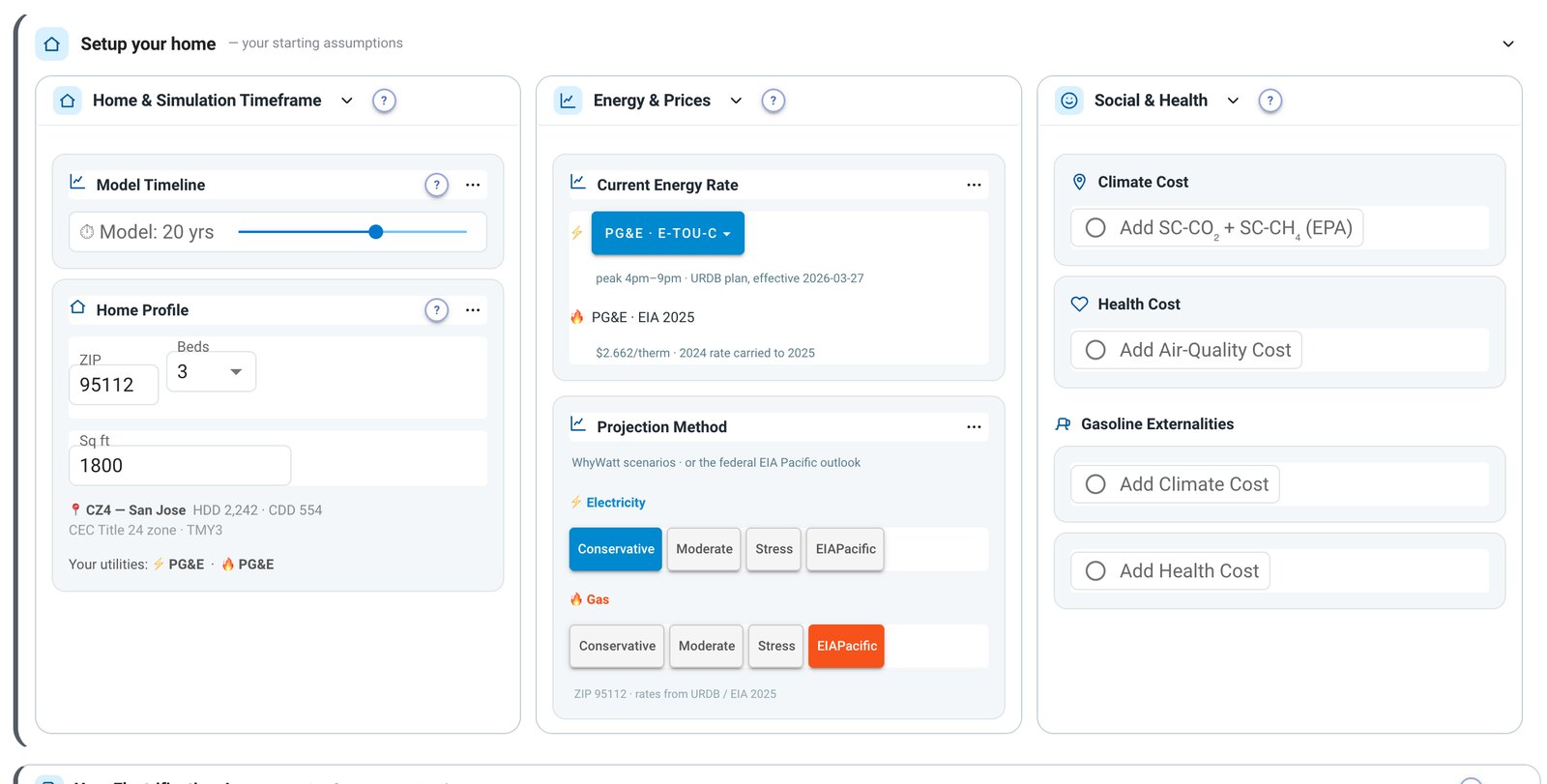
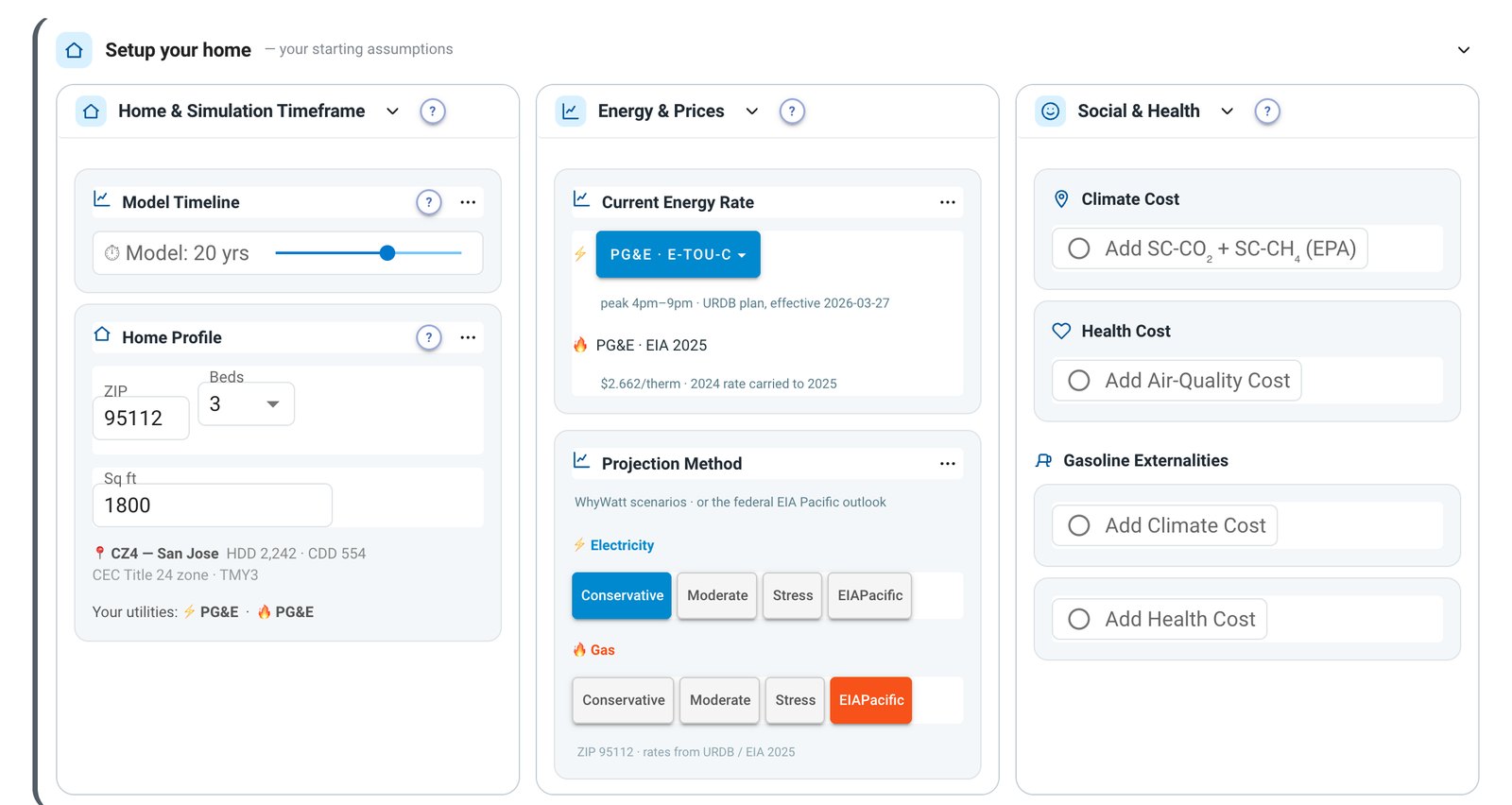
- Home & timeframe. ZIP, bedrooms and square footage set your California climate zone and find your utilities. Model horizon: 20 yrs.
- Current Energy Rate. Your utility's actual plan — here PG&E · E-TOU-C, with its 4–9pm peak — and your gas utility's 2025 rate.
- Projection Method. How prices grow: WhyWatt Conservative (default), Moderate, Stress, or the federal EIA Pacific outlook — chosen separately for electricity and gas.
- Social & Health. Optional climate and air-quality costs of gas and gasoline.
04 · Meet WhyWatt · 3 of 3
Plan your electrification journey
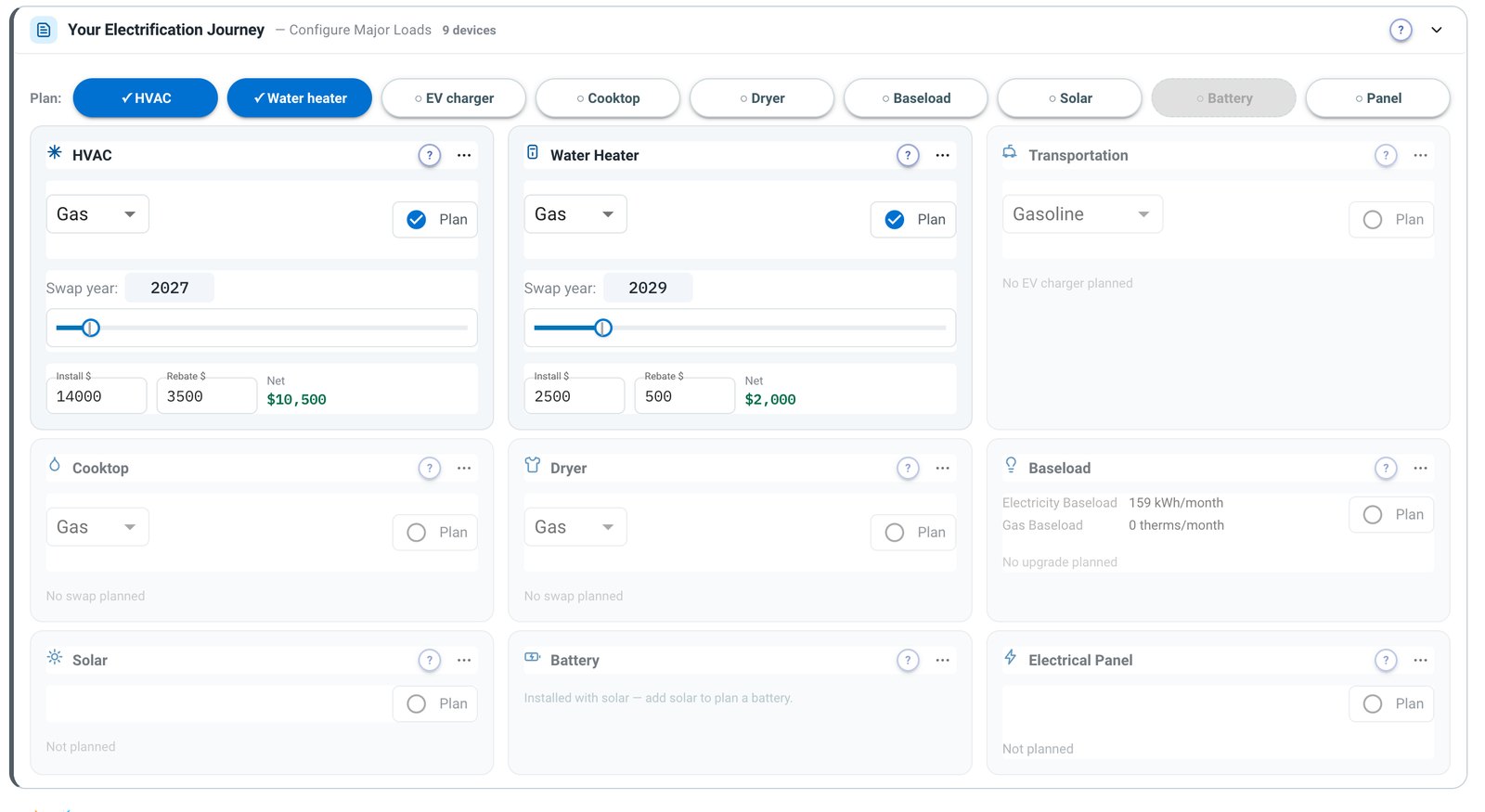
- Nine device cards. Each holds a starting fuel, a swap year, and install / rebate / net cost.
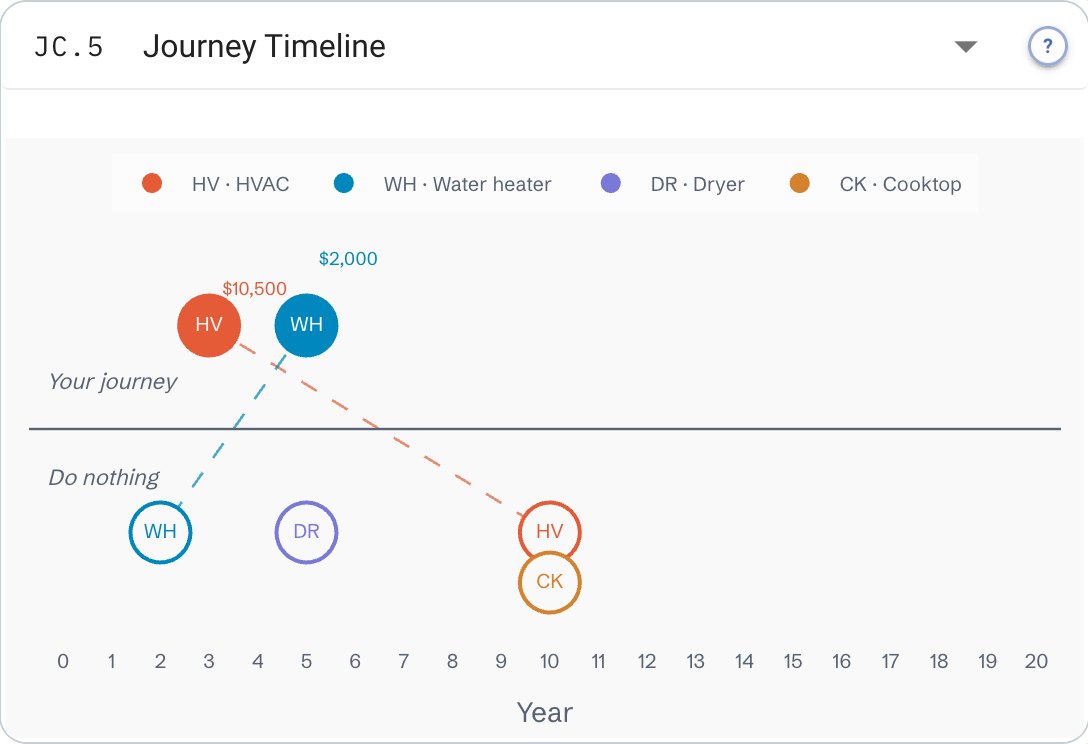
- HVAC → heat pump, 2027, net $10,500.
- Water heater → HPWH, 2029, net $2,000.
- Transportation, cooktop, dryer, baseload — the rest of the home, each on its own timeline.
- Solar, battery & panel — now full journey cards.
05 · Detail views · 1 of 7
Rates & projections
- One current rate. What you pay today is a fact about your home, so both scenarios share it: PG&E · E-TOU-C and gas at $2.662/therm.
- Projection = shape, not price. Your current rate is grown by the chosen curve's year-to-year change — no escalation slider needed.
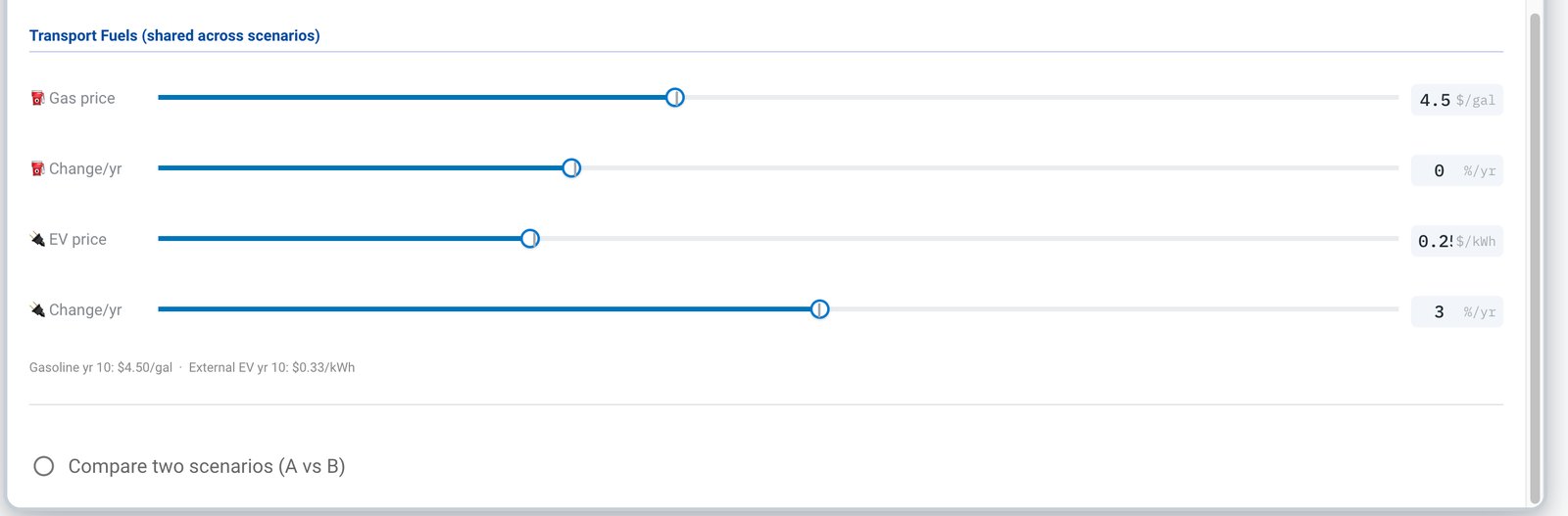
- Transport fuels. Gasoline $4.50/gal and public EV charging $0.25/kWh, shared across scenarios.
- What-if. Tick Compare two scenarios (A vs B) to test a second projection side by side.

06 · Detail views · 2 of 7
HVAC — heating & cooling
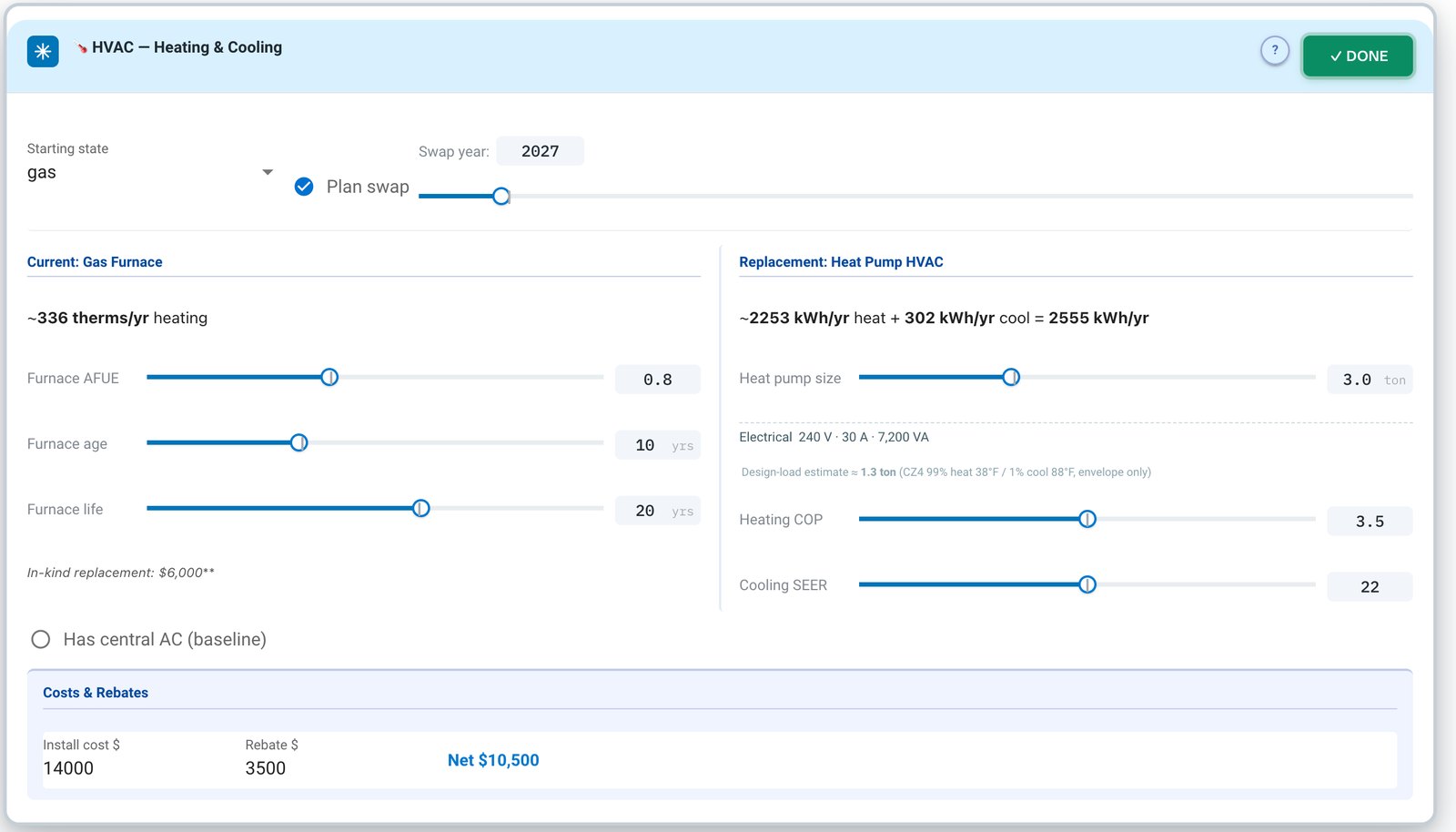
Every card opens a detail page. Gas furnace today, heat pump planned for 2027.
- Side by side. Furnace ~336 therms/yr vs. heat pump ~2,555 kWh/yr (heating + cooling).
- Real parameters. AFUE 0.8 → COP 3.5, SEER 22, furnace age & life.
- Sizing & wiring. 3.0 ton unit on 240 V · 30 A; design load for CZ4 shown alongside.
- Adds cooling. "Has central AC" is off — the heat pump brings AC the home never had.
07 · Detail views · 3 of 7
Water heater
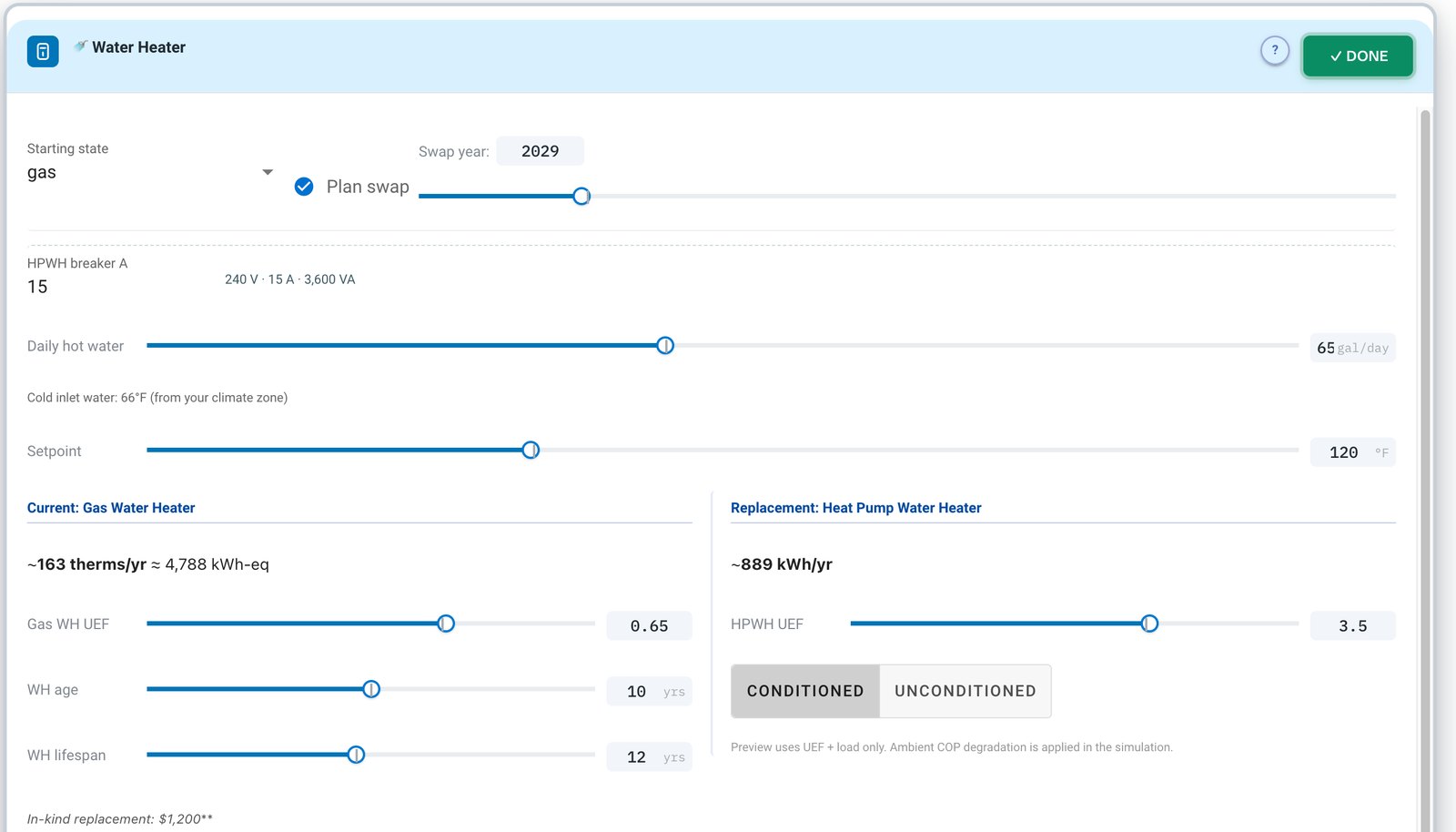
- Side by side. Gas ~163 therms/yr vs. heat-pump water heater ~889 kWh/yr.
- Your hot water. 65 gal/day, 120 °F setpoint; cold-inlet temperature comes from your climate zone.
- Efficiency. UEF 0.65 → 3.5, installed in conditioned or unconditioned space.
- Wiring. The HPWH needs a 240 V · 15 A breaker.
08 · Detail views · 4 of 7
Transportation — EV + charger
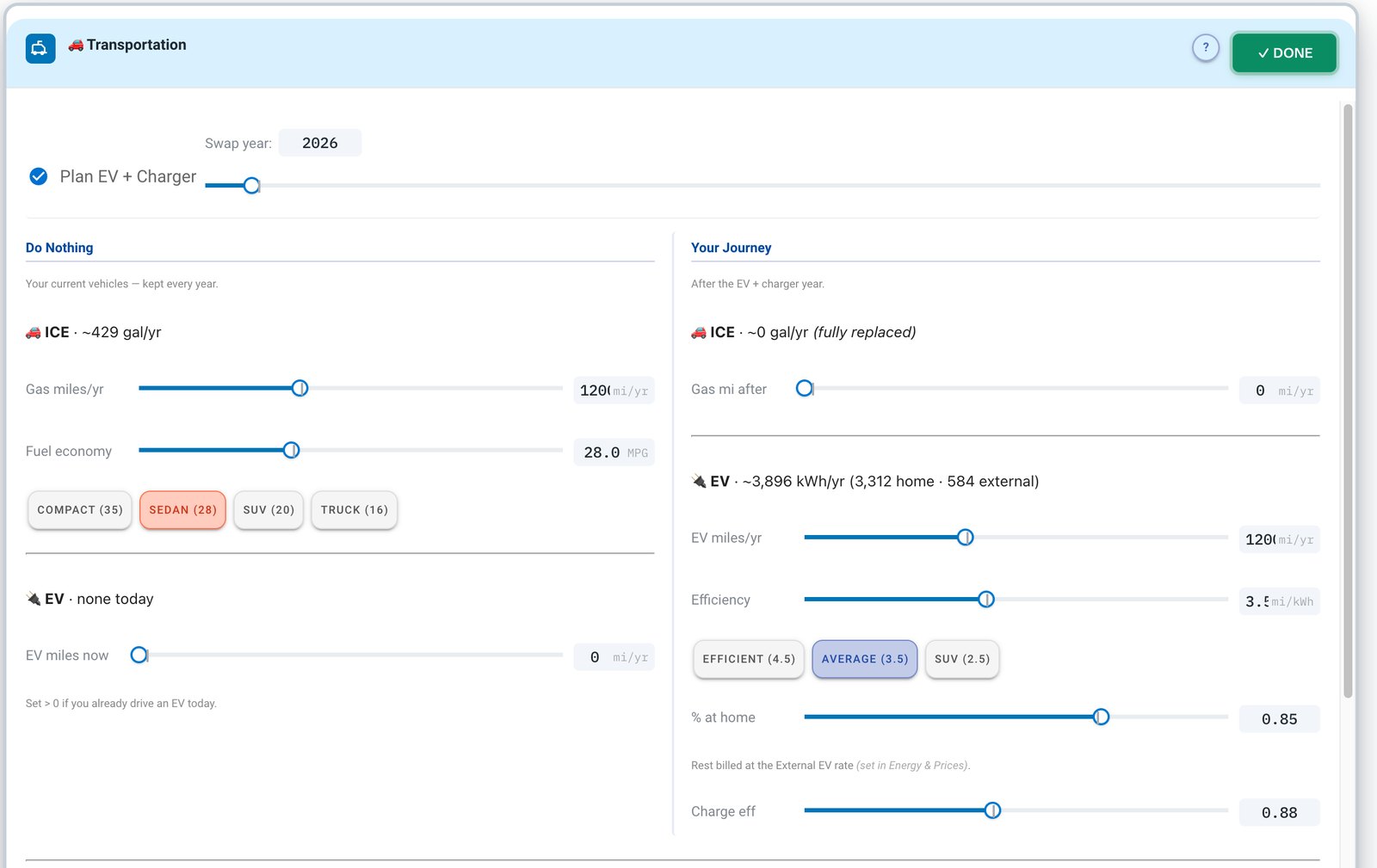

- Do nothing. Keep the gas car: ~429 gal/yr at 28 MPG.
- Your journey. EV from 2026: ~3,896 kWh/yr — 85% charged at home, the rest at public rates.
- Charger. L2 at 32 A · 7.7 kW, net $800 — hardware only; the car itself isn't modeled.
09 · Detail views · 5 of 7
Cooktop & dryer
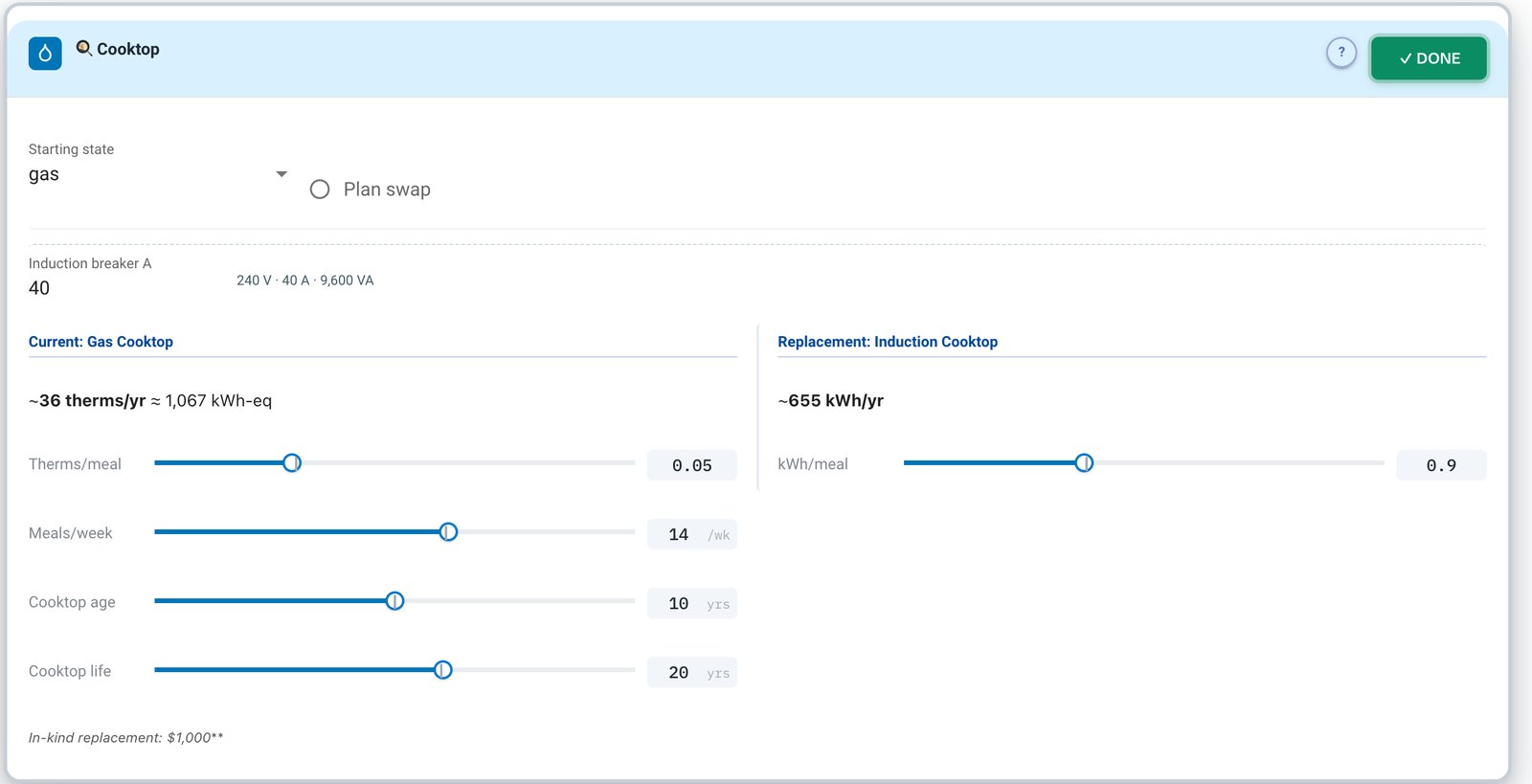
- Cooktop. Gas ~36 therms/yr → induction ~655 kWh/yr, from meals per week. Needs 240 V · 40 A.
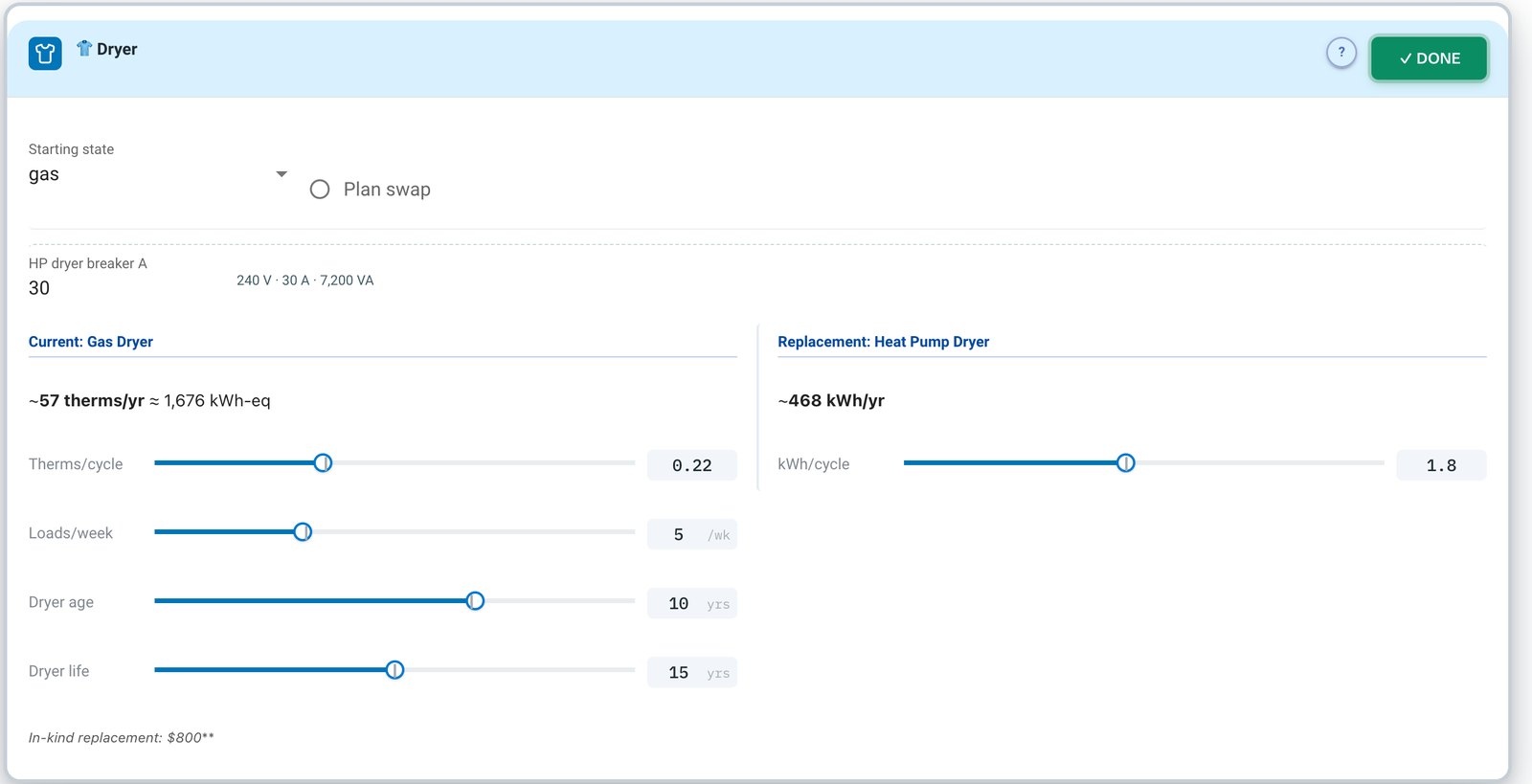
- Dryer. Gas ~57 therms/yr → heat-pump dryer ~468 kWh/yr, from loads per week. Needs 240 V · 30 A.
- Age & life. Each tracks when the old unit wears out — that sets the like-for-like replacement under do nothing.
10 · Detail views · 6 of 7
Solar + battery
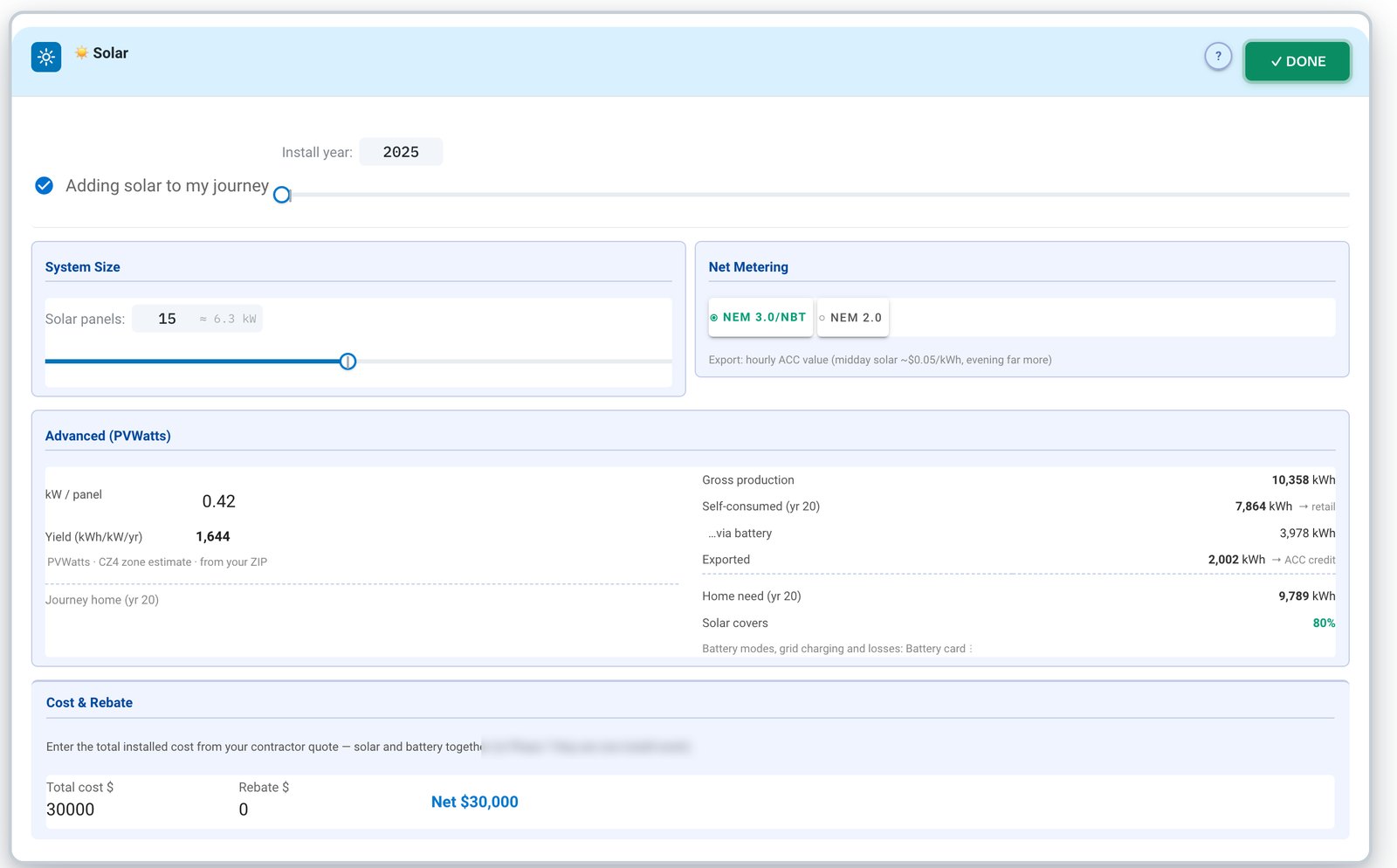
- Solar from your ZIP. 15 panels · 6.3 kW produce 10,358 kWh a year (PVWatts).
- NEM 3.0. Exports earn the hourly avoided-cost value — little at midday, far more in the evening.
- Covers 80% of the home's year-20 need; only 2,002 kWh is exported.
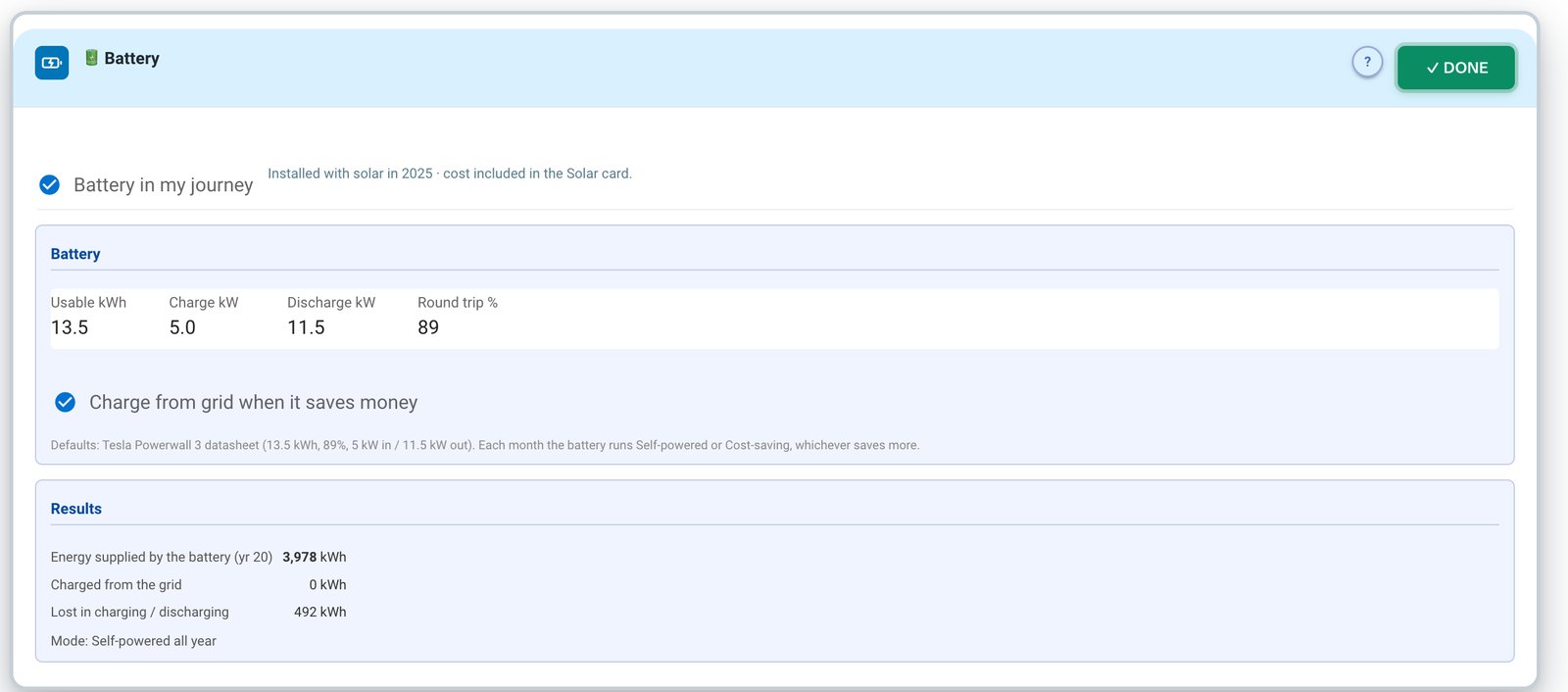
- Battery. Powerwall 3 defaults (13.5 kWh). Each month it runs Self-powered or Cost-saving, whichever saves more — here it supplies 3,978 kWh.
11 · Detail views · 7 of 7
Electrical panel
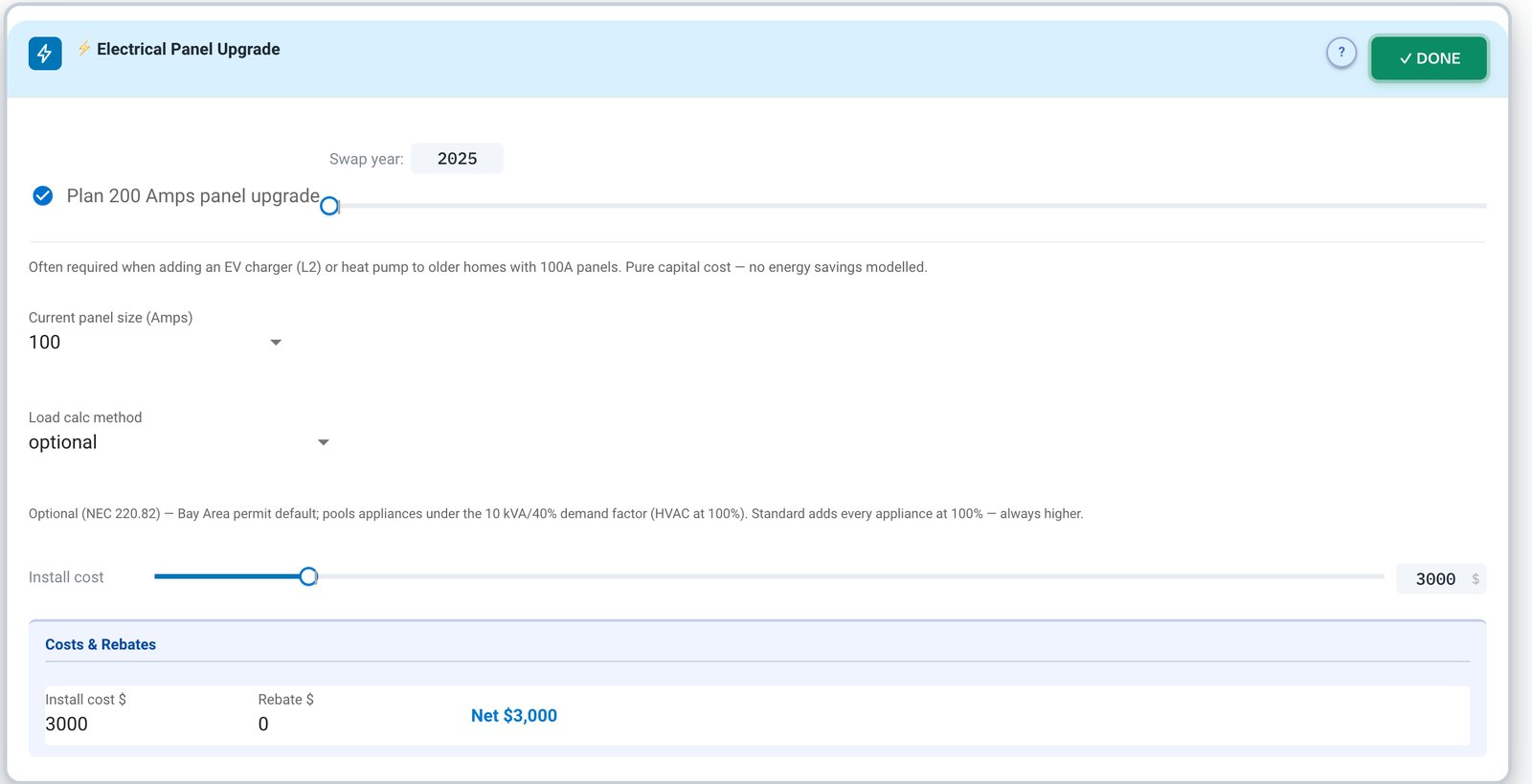
- When amps run out. An L2 charger or heat pump often pushes an older 100 A panel past its limit.
- Code-based estimate. Peak load follows NEC 220.82 (optional method) — the Bay Area permit default.
- Plan the upgrade. 200 A in the year you need it, net $3,000 — pure capital, no energy saving.
- Ties to the cockpit. Panel guidance flags when your plan exceeds capacity.
Replace-on-failure · 1 of 2
The Technophile
Researches carefully, replaces on failure, and isn't especially price-sensitive. Goes heat pump for both heating and hot water.
- The plan. HVAC → heat pump 2027, water heater → HPWH 2029. Everything else stays gas.
- The rates. Electricity on WhyWatt Conservative, gas on the federal EIA Pacific outlook.
- Energy only. Social & health costs are left off — a pure dollars-and-cents view.
Replace-on-failure · 2 of 2
The Technophile — the verdict
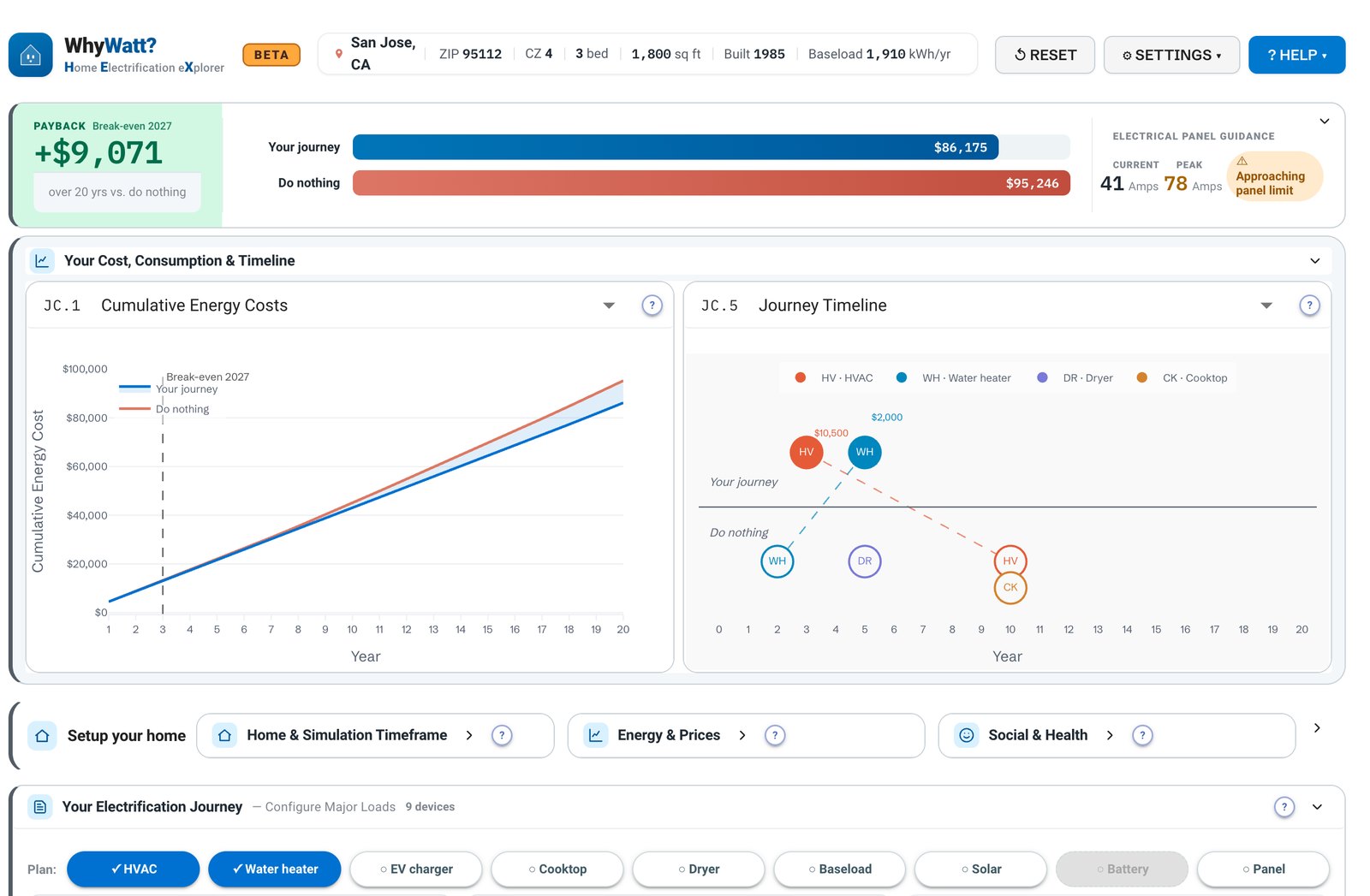
- Modest, but positive. Break-even in 2027; +$9,071 ahead on energy over 20 years ($86,175 vs. $95,246).
- Check the capital side. $12,500 net for two heat pumps vs. like-for-like replacements — see JC.4 (CapEx).
- You're buying cooling, too. No AC today — part of the spend buys comfort.
- Panel headroom. Peak 78 A — near the limit before any EV.
Appliance refresh + EV · 1 of 2
The EV Family
An EV-owning, socially-minded household — adds a charger, moves every appliance off gas, and layers in solar + battery.
- Counts the hidden cost of gas. Climate (SC-CO₂ + SC-CH₄) $1.07/therm and air quality $1.23/therm.
- …and of gasoline. Climate $1.69/gal and health $0.75/gal.
- Same rates as the Technophile. Electricity Conservative, gas EIA Pacific — so the difference is the plan.
Appliance refresh + EV · 2 of 2
The EV Family — the verdict
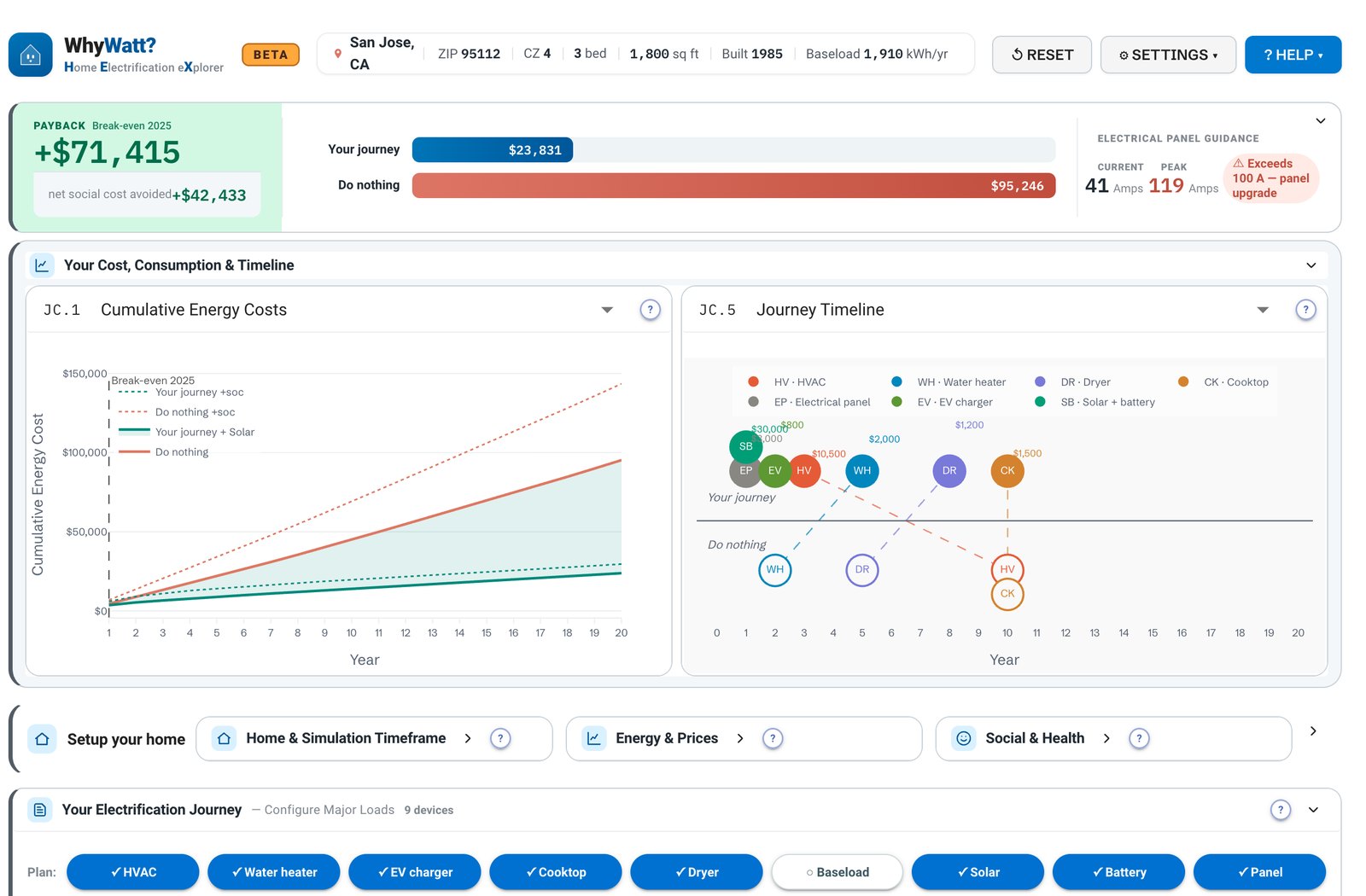
- Big energy saving. Break-even 2025; +$71,415 over 20 years ($23,831 vs. $95,246).
- Strong social return. +$42,433 avoided climate & health cost.
- The panel is the constraint. Peak 119 A exceeds the 100 A panel — the plan adds a 200 A upgrade ($3,000). Guidance still warns: it measures today's panel.
- Capital is real. ≈ $49,000 planned, $30,000 of it solar + battery — see JC.4 (CapEx).